Wave-Energy Converters: Turning Ocean Motion into Electricity
Watching a buoy rise and fall makes the energy in waves easy to notice. Turning that motion into useful electricity is more difficult. A wave-energy converter must capture irregular movement, turn it into a controlled power flow, and survive the environment that supplies it.
More than one kind of machine
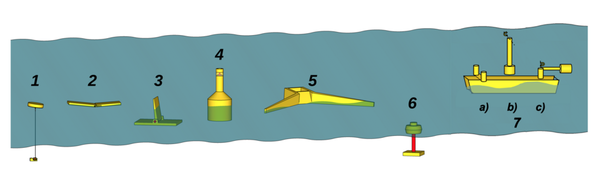
The European Marine Energy Centre, or EMEC, identifies several wave-converter designs. A point absorber uses the motion of a floating component relative to another part of the device. An attenuator captures relative motion along a floating structure positioned with the wave direction.
An oscillating water column works differently. It encloses air above water in a partially submerged chamber. As waves move the water up and down, air flows through a turbine. The movement of the air provides a route from wave action to rotating machinery and electricity.
DOE’s marine-energy glossary distinguishes these concepts because different machines interact with different parts of wave motion. There is no single physical shape that all wave-energy systems must take. The location and desired use help determine the design.
From motion to useful power
Capturing movement is only one step. A converter needs a power take-off arrangement, equipment to handle the resulting energy, and a connection to its intended load. The design has to function under changing wave conditions rather than only in one convenient laboratory setting.
Imagine a research team testing a small converter for an offshore instrument. Its first question might be whether the device supplies enough usable energy over the instrument’s actual operating period. The team would also need to know when production is low and how the instrument behaves during those periods. This is an illustrative test scenario, not a claim about a deployed system.
Why testing must be broad
A persuasive demonstration should describe the sea conditions, test duration, maintenance events, and method used to measure output. A peak value during a favorable wave is not the same as sustained useful production. Clear reporting makes different concepts easier to compare.
The machine also needs to survive rough conditions and remain serviceable. A moving structure that captures energy must manage the forces acting on it. The equipment may need inspection and repairs in places where access depends on weather and specialized vessels.
These practical constraints help explain why an attractive resource does not automatically become inexpensive electricity. A successful design has to balance capture, durability, accessibility, and the costs of its supporting systems.
Summary
Wave-energy converters use approaches such as moving floats or oscillating air columns to transform ocean motion into electrical energy. Their promise is easy to see in the waves themselves. Their practical value depends on dependable output and the ability to operate, survive, and be maintained in a demanding marine setting.
Works Cited
European Marine Energy Centre. “Wave Devices.” n.d. Accessed 10 Oct. 2026.
U.S. Department of Energy. “Marine Energy Glossary.” n.d. Accessed 10 Oct. 2026.
Hmarcollo. “WECs-2020.” Wikimedia Commons, 17 July 2020. Image. CC BY-SA 4.0. Accessed 10 Oct. 2026.
Published illustrations of different wave-energy converter concepts. Image: Hmarcollo; CC BY-SA 4.0.