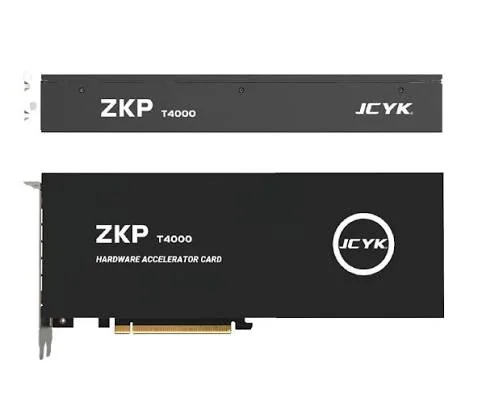
Zero-Knowledge Proof (ZKP) hardware accelerators enable distributed privacy. ASIC and FPGA accelerators democratize verifiable compute as cryptographic privacy smart contracts, decentralized identity, and zk-rollups proliferate across edge networks. But cryptographic proof generation creates extreme computational overheads. To mitigate this "proving bottleneck", hardware accelerators offload complex cryptographic operations for fast, low-power proof generation at the edge.
1. The Proving Bottleneck in Distributed Zero-Knowledge Systems
Proof generation on CPUs/GPUs introduces extreme operational and architectural constraints for distributed edge nodes implementing zero knowledge:
Extreme Computational Overhead: Prover operations can be to more compute-intensive than raw execution, stressing limited edge device CPU/GPU resources.
Memory Saturation and High Bandwidth Requirements: Core mathematical kernels involve loading gigabytes of polynomial coefficients and elliptic curve points, creating crippling memory bandwidth limitations and high power draw.
Latency Bottlenecks for Interactive Use Cases: Slow proof generation impacts latencies for real-time biometric authentication, local credential verification, and low-latency confidential transactions.
2. Silicon Architecture: Hardware Accelerating Core Cryptographic Kernels
Specialized zero-knowledge silicon accelerators target the most compute-intensive mathematical kernels:
Multi-Scalar Multiplication (MSM) Engines: MSM dominates proving time in many curve-based zk-SNARKs. Custom accelerators employ dense crossbar arrays of Digital Signal Processors (DSPs) and wide-integer adders/multipliers to accelerate millions of elliptic curve scalar multiplications in parallel.
Number Theoretic Transform (NTT) & FFT Pipelines: NTT operations form the core of polynomial-based zk-STARKs. Zero-knowledge hardware employs ultra-fast on-chip High Bandwidth Memory (HBM) and multiple-bank SRAM architectures to accelerate the highly parallel, non-contiguous memory access patterns of FFT/IFFT algorithms.
Hardware-Friendly ZK Hash Accelerators: Specialized execution pipelines accelerate ZK-friendly hash algorithms (Poseidon, Rescue, Rescue-Prime) and FRI (Fast Reed-Solomon Interactive Oracle Proofs of Proximity) protocols, dramatically accelerating Merkle tree commitment operations.
3. FPGA vs. ASIC Approaches to Evolving Cryptographic Standards
Hardware developers balance flexibility vs. efficiency as zero-knowledge proof protocols rapidly evolve:
Reconfigurable FPGA Acceleration: Field-programmable gate arrays accelerate evolving zero-knowledge proof protocols (e.g., switching between Groth16, PLONK, and STARKs proofs via bitstream re-flashing). FPGAs also employ high-bandwidth memory and custom integer arithmetic units without requiring specialized ASIC fabrication.
Dedicated ZK-ASIC Performance: Purpose-built ASICs achieve order-of-magnitude gains in proof generation performance while reducing power consumption compared to GPUs. ASICs accelerate ZKP generation by embedding domain-specific processing elements (ZPUs or ZK Processing Units).
Co-Designed SW/HW Frameworks: Domain-specific instruction set architectures and hardware abstraction layers (e.g., ICICLE) enable portable high-level ZK circuit description languages targeting CPUs, FPGAs, or ASICs.
4. Distributed Privacy Applications & Deployment Roadmaps
Integrating hardware-accelerated ZKP engines unlocks a range of distributed privacy applications:
Confidential Edge AI & Biometric Verification: Edge devices employ ZKP hardware to generate proofs of identity or AI inferencing results, while keeping biometric samples, private keys, and sensor data inside secure enclaves.
Decentralized Prover Networks: Distributed networks of prover nodes offload computationally intensive proof generation to specialized zero-knowledge hardware, enabling mobile clients to delegate confidential computing operations.
Private Internet of Things (IoT) Integrity: Embedded ZKP hardware accelerators generate tamper-proof proofs of state and location, enabling privacy-preserving IoT device authentication.
Sources
- JCYK Technology. (2026). JCYK ZKP T4000 hardware accelerator card for zero-knowledge proof computing [Photograph]. GODSPM. https://www.godspm.com/en/product/ZKP-T4000.html