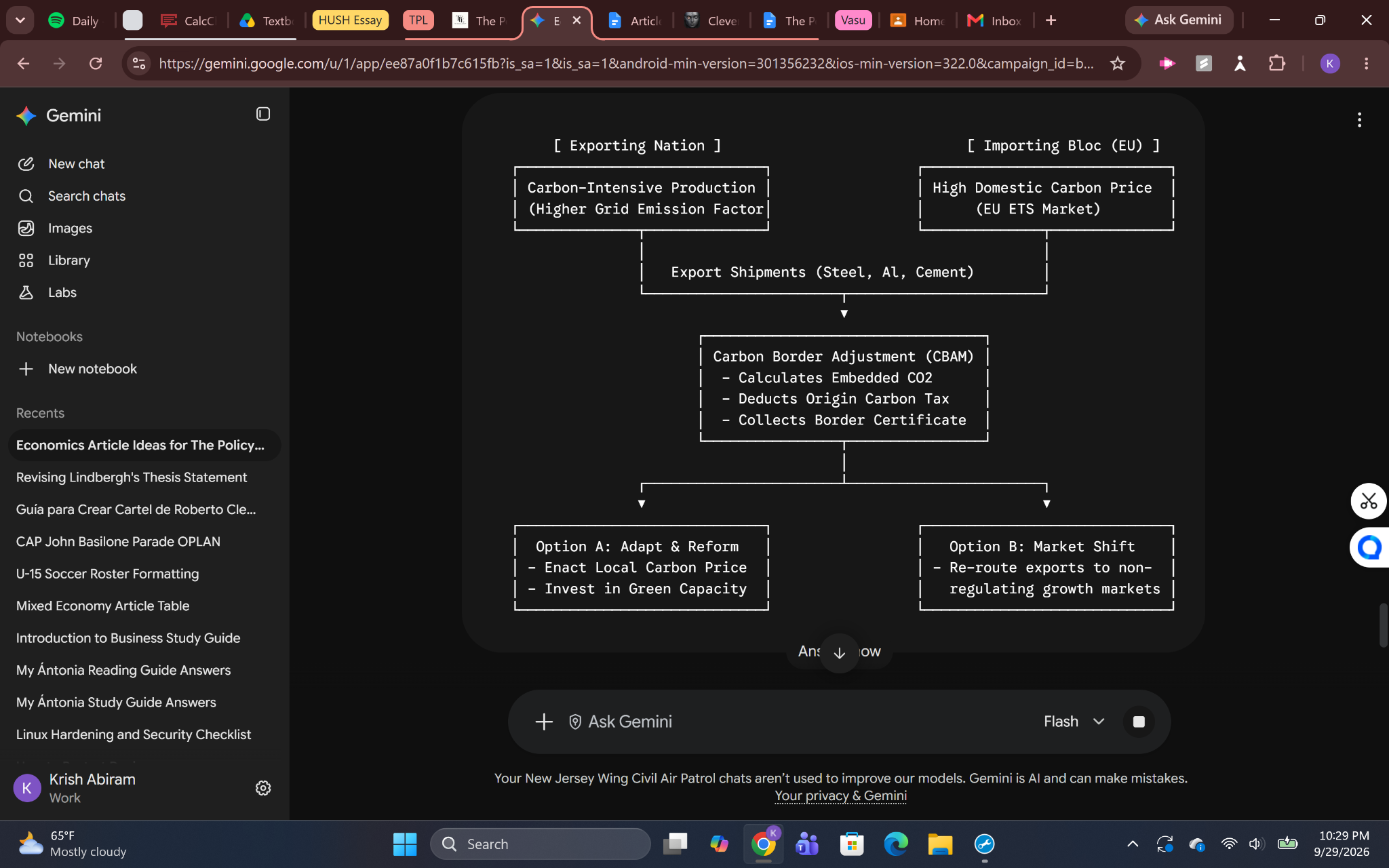
How green trade policy and carbon border taxes are reshaping export economics and deepening North-South economic friction.
On January 1, 2026, the European Union's Carbon Border Adjustment Mechanism (CBAM) enters its final compliance period. Following two years of transition in which carbon intensity data collection took precedent over implementation, carbon footprints shift from a reporting parameter to a financial levy. Importers of carbon intensive goods are required to purchase CBAM certificates to offset the carbon intensity of imported goods, equal to the market price of carbon on the EU Emissions Trading System (EU ETS).
While the mechanisms sought to ensure that carbon leakage does not occur, they represent a significant shift in international trade relations to the detriment of developing and emerging economies.
The Mechanics of Border Adjustments
Border Carbon Adjustments function on the principle that incoming international trade goods bear the same carbon levy cost as domestic primary production. The proposed EU scheme (a model for the UK, Canada, Australia) as well as the US proposal seek to impose a carbon levy on imports of steel, aluminum, cement, fertilizers, electricity, and hydrogen. In order to calculate a border levy, firms will apply a net formula based on:
- Embedded Emissions: Verified supplier carbon intensity or a default carbon value that applies penalties for non-verified reporting.
- ETS Differential: The price differential of emissions allowance between the EU and the importing firm's home country, adjusted for free allocation remaining during the phase-out period.
- Deductible Carbon Costs: Taxes and carbon specific emission fees incurred in the production state. The above represents a significant financial incentive for governments of export-oriented economies to establish their own carbon pricing mechanisms. Otherwise emissions revenues on international trade will be transferred to the territories of importing countries.
Export Exposure and the Developing World
For developing economies a significant proportion of total export revenues is concentrated in foundational primary production sectors.
In countries such as India, South Africa, Egypt, Mozambique, and several Latin
American economies, steel, aluminum ingots, and fertilizers comprise a significant source of foreign exchange earnings, supporting broader industrial development. Compared to developed world economies, developing countries bear three significant disadvantages under a BCA regime:
- Energy Grid Carbon Intensity: Many developing countries continue to rely on coal for baseline power generation. Thus even if an emerging market steel mill utilizes cutting-edge production technology, the embedded scope 2 emissions will be penalized due to the higher carbon intensity of the local electricity grid.
- The Cost of Decarbonization Capital: Many developing economies face significantly higher costs of capital and sovereign risk premia in comparison to the developed world. Thus, the upfront capital expenditure of switching to green hydrogen-based steelmaking, or CCUS-equipped cement production represents an existential risk to the balance sheets of emerging market firms.
- MRV Infrastructure and Administrative Burdens: In order to qualify for emissions intensity defaults under the CBAM, producers need to possess verifiable supply chain emissions data at the facility level. In the case of small to mid-sized enterprises across the Global
South, this may entail being subjected to significant default value penalties in order to
obtain third party verification of emissions statements.
"Green Protectionism" and Trade Disputes
The introduction of BCAs has reinvigorated disputes in the World Trade Organization and international climate negotiations. The developing world argues that a unilateral carbon levy represents a violation of the principle of "Common But Differentiated Responsibilities" (CBDR) stipulated in the Paris Agreement.
Under the CBDR principle, the historical responsibility of advanced economies for carbon emissions necessitates climate finance to support the developing world in its transition to a low carbon economy. BCAs are perceived as "green protectionism": a means for advanced economies to shield their domestic heavy industry from international competition by imposing additional trade barriers.
Several developing economies such as India, China, and Russia have pursued legal action in the World Trade Organization to challenge the extra charges as disguised trade restrictions.
Strategic Market and Regulatory Responses
Given the inevitability of border carbon adjustments, governments and exporters of the developing world are exploring several strategic responses:
- Internalizing Carbon Revenues: Governments such as Brazil, Turkey, and Vietnam are moving to establish domestic carbon markets or direct carbon taxation regimes. This allows them to offset potential revenue losses due to BCAs while providing financing for their own transition to a low carbon economy.
- Industrial Bifurcation: Multinational exporters are considering a bifurcation of their production capacities. Low emission production facilities can be directed towards high regulation export markets while capacity equipped with conventional furnaces can shift towards the domestic market.
- Leapfrogging: Several developing economies with high potential for renewable energy generation are looking to leapfrog traditional industrialization and position themselves as low carbon manufacturing hubs.
Outlook
The introduction of carbon border adjustments represents the end of a policy era in which climate change was a separate consideration from international trade. As emissions intensity becomes a determining factor for export competitiveness, the gulf between economies with low cost renewable energy and carbon capture capabilities will grow. In order to participate in international trade, developing world economies must navigate a precarious balancing act between building up local carbon accounting infrastructure, obtaining climate finance and technology from developed economies, and decarbonizing their industrial and manufacturing sectors at a rapid pace.
Works Cited
"The State of Border Carbon Adjustments 2026," International Institute for Sustainable Development (July 2026).
"Emissions pricing: How the EU's CBAM is impacting global trade," EFG International Insights (February 2026).
"EU CBAM enters compliance phase and outlines path ahead," International Carbon Action Partnership (January 2026).
"CBAM from 2026: What It Means for Business," ESG Platform (January 2026).