
As soon as economic problems become a matter of public concern, most of the conversation about them centers on the White House. Indeed, many elections have hinged on the economy, captured succinctly by James Carville’s memorable catchphrase, “It’s the economy, stupid.” An incumbent president whose term coincides with economic growth will usually win reelection, and vice versa for economic decline. Although the president has a degree of influence over the economy, he or she does not play nearly as important a role as Congress and the Federal Reserve via fiscal and monetary policies, respectively.
Fiscal Policy
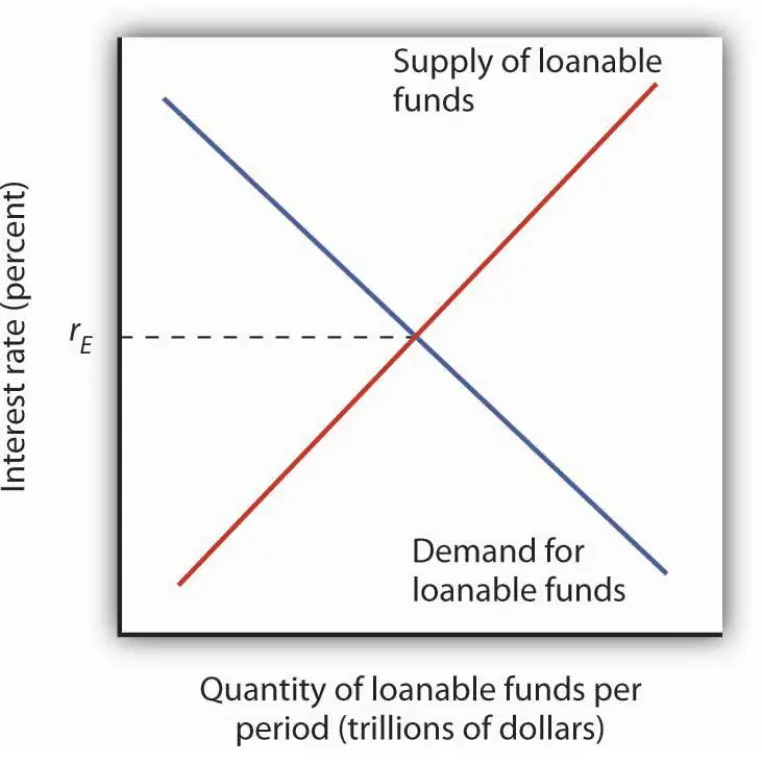
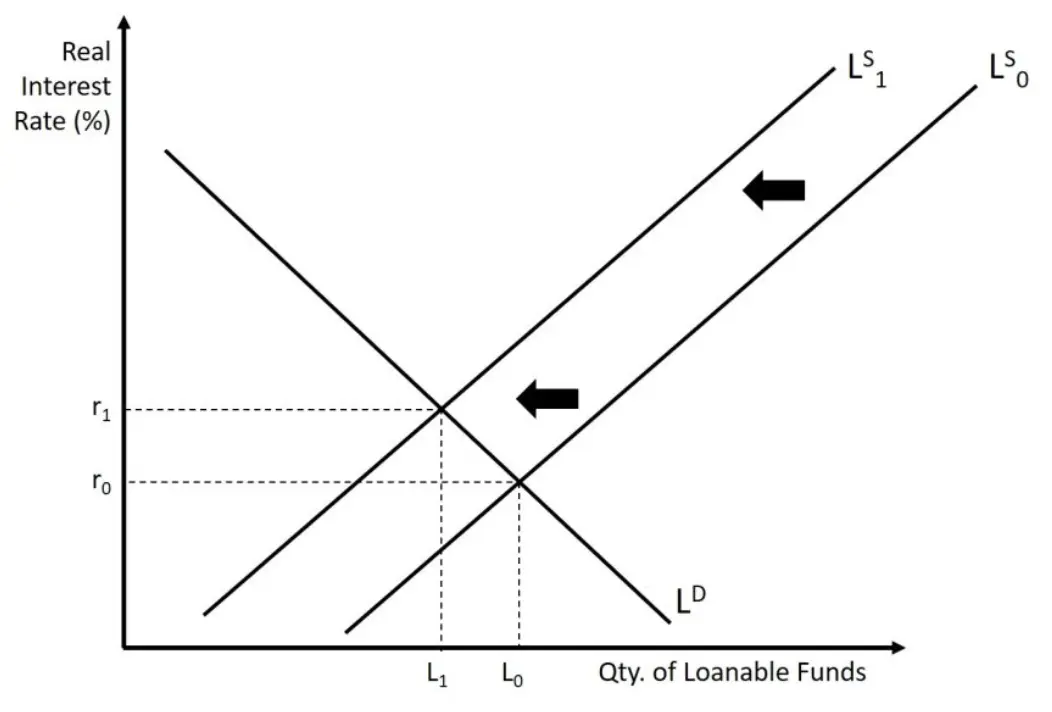
The fiscal policy refers to measures directly implemented by the federal government that have a bearing on the economy. This can easily be illustrated through the loanable funds market graph.
Discretionary spending is an example of fiscal policy. The signing of the Bipartisan Infrastructure Law by President Biden in 2021 allowed the federal government to utilize tax dollars towards different goals as set out in the legislation. If the government borrows funds to finance such an expansion of its activities, then the supply of loanable funds will reduce since the government is borrowing from the initial supply of loanable funds. This causes an increase in the real interest rate, referred to as “crowding out.”
An example of fiscal policy would also be the reduction of taxation. For example, many Republicans think that reduction in the corporate tax rate can boost the long-term aggregate supply because companies would find ways to be more productive. Whatever the policy may be, it is up to Congress to come up with the bill. Otherwise, the president won't have any impact on the economy at all. The two have to work together in order to develop effective fiscal policy.
Monetary Policy
In contrast, monetary policy is entirely unrelated to the government and is set by the Federal Reserve, which is the central bank of America. In general, there are three ways a central bank may apply its monetary policy, such as changing the discount rate, performing open market operations, and changing the reserve requirements. I will consider only the first two for the sake of brevity.
Changing the discount rate is extensively mentioned in the media and is the best-known case of the application of monetary policy. The discount rate is basically the minimum interest rate on the loans offered by financial institutions. If the discount rate drops, it is referred to as expansionary monetary policy, as it leads to borrowing due to lower prices for loans. In contrast, raising the discount rate hinders borrowing, which is called contractionary monetary policy. The former is the preferred option for the Fed nowadays since there is going to be less money and spending in the economy and, therefore, less inflation.
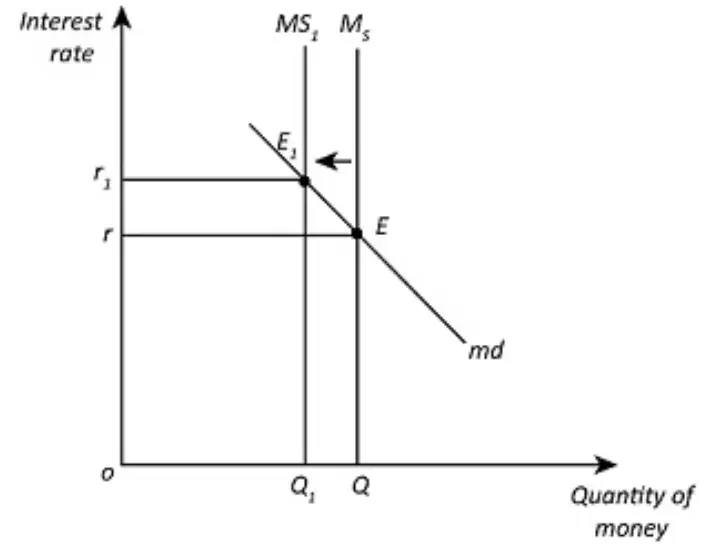
The other important instrument of monetary policy is the open market operation. It entails the Federal Reserve's capability to buy and sell bonds in the open market. This effect will be explained better through the graph of the money market.
When the Fed sells bonds on the open market, the money supply in the country becomes smaller, because the bond buyers have to return money to the Fed to buy their bonds. In such a way, the nominal interest rate increases, thus, investments become discouraged, while the aggregate demand is decreased. When the Fed uses this instrument of monetary policy, the economy has already been inflated, and the Fed wants to decrease it. On the other hand, the Fed can buy bonds on the open market, and the opposite process will take place.
One distinctive feature of the Federal Reserve System that is usually ignored is its independence. In spite of whatever views and decisions are formed by the politicians, the Federal Reserve is always an independent institution. Nevertheless, the politicians are usually blamed or credited for decisions made by the Federal Reserve because even though they have a certain influence on the choice of the chairman, they do not control monetary policy.
Conclusion
It is important for people to have knowledge about the differences between fiscal and monetary policies because, by doing so, one would be able to draw conclusions concerning the current state of our economy and how we should move forward. The application of both fiscal and monetary policies is a complex process requiring coordination among different parts of the government. That is why I suggest people to think of the current state of our economy practically and realize that it takes much more than just one leader in the White House to achieve something.